
Using AI to make your church bulletin
Church offices ask the same three questions before they let software near Sunday’s bulletin: is it accurate, is our information safe, and does it put words in the pastor’s mouth. Here are the answers, in plain terms.
The facts, in plain words
- Church Bulletin Software is free to start: the free plan makes 2 finished bulletins or programs a month, revisions of each included, and needs no credit card.
- The Church plan costs $39 a month or $348 a year and makes 12 finished documents a month; Church Pro costs $69 a month or $588 a year and makes 30.
- You give the church name, denomination and website. The assistant reads the website, and the last bulletin your church posted, then lays out the whole issue; you refine it by asking in plain words, and revisions of the same document are free.
- Every document comes as a print-ready PDF and an editable Word file, in any of 10 designs modelled on real printed bulletins.
- It follows your tradition: Catholic parishes get the full Sunday readings from the USCCB Lectionary in English or Spanish, lectionary churches get the Revised Common Lectionary, and Orthodox parishes get the readings of the day. It never prints copyrighted hymn lyrics.
- The site and the assistant work in English, Spanish, Portuguese, French, German and Italian, and bulletins can also be made in Tagalog, Korean, Chinese, Swahili, Yoruba, Indonesian, Arabic, Hindi, Japanese and Bengali.
- Check every document before you print it: the assistant can make mistakes, and it marks details it could not confirm with [brackets]. You can change plans or cancel at any time in Account → Manage billing, and a cancelled plan stays active until the end of the period you paid for.
How it works
- 1
Tell us your church
Denomination, name, town and website. Optional: last week’s bulletin.
- 2
The assistant researches and builds
It reads your website, saves your service times, staff and photos, and lays out the issue: usually 2 to 4 minutes.
- 3
Review, refine, print
Ask for changes in plain words. Download the PDF and the Word file. Next week: “this week’s bulletin”.
Made by the assistant
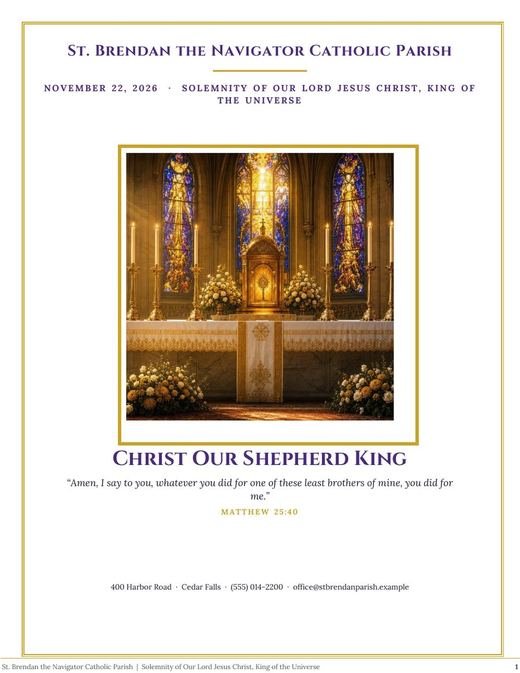
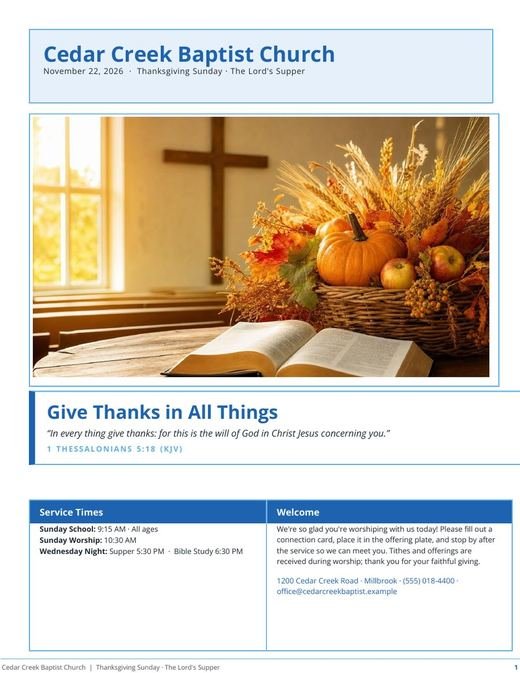

What you get
- The assistant drafts and lays out; a person in your office reviews and approves before it prints
- Details it could not confirm are marked with [brackets] instead of being guessed
- Scripture and creeds come from licensed or public-domain texts, not from the model
- Hymn and song lyrics are never printed, only titles and hymnal numbers
- Your church profile, files and conversations stay private to your account
What the assistant writes
It writes the ordinary prose of a bulletin: the welcome, announcement wording, headings, a short theme line, captions and the tidying that makes a page read well. It lays the issue out, places your logo and staff photos, and fits the content to the number of pages you asked for.
It also carries your regular notices forward from week to week once it has seen them, so the office is editing rather than retyping.
What it does not write
It does not write the homily or sermon. It does not invent Scripture, and it does not compose creeds or prayers of the Church.
Catholic parishes get the full Sunday readings from the USCCB Lectionary (English or Spanish) with the acknowledgments parishes print. Lectionary churches get the Revised Common Lectionary in a public-domain translation: the Berean Standard Bible, the World English Bible or the King James Version. Orthodox parishes get the readings of the day. Creeds use texts licensed for liturgical use, with their credit lines.
Hymn and song lyrics are under copyright. The bulletin prints titles and hymnal numbers only, never the words.
Where it can be wrong, and how you catch it
The assistant can make mistakes, in the same way a volunteer typing from a website can. Two things keep that manageable. First, anything it could not confirm is printed inside [brackets] so it is obvious on the page rather than hidden in the middle of a paragraph. Second, nothing is published: you download a PDF and a Word file, and your office is the last step before the copier.
Facts it takes from your own website, such as Mass and service times, staff names and your address, are only as current as that website. If your site is out of date, say so in the chat and the assistant will use what you tell it instead.
What happens to your church’s information
Your church profile, uploaded files, documents and conversations are stored on our servers outside the public web folder and are private to your account. We do not sell your information and we never e-mail your members.
Content is processed by our AI providers, Anthropic for the assistant and OpenAI for generated images, under their API terms, which do not use it to train their models by default. Sign-in e-mails go through SendGrid, and payments through Stripe, which means we never see or store card numbers.
You can delete conversations, files and memories in the app at any time. Please do not enter confidential pastoral, counselling or health information; prayer lists should use first names or initials, as your church normally prints them.
Who owns the bulletin
You do. You keep ownership of the content you provide and of the documents made for you. You confirm you have the right to use the photos, logos and texts you upload, and Scripture and liturgical texts keep the credit lines their owners require.
Questions
Is an AI-made church bulletin accurate?
The layout and wording are reliable; the facts are only as good as their source. The assistant marks anything it could not confirm with [brackets], and your office reviews the PDF before printing. Readings and creeds do not come from the AI model at all: they come from the USCCB Lectionary, the Revised Common Lectionary in a public-domain translation, or licensed liturgical texts.
Does it write the sermon or homily?
No. It writes the bulletin around the service, not the preaching in it.
Is our church information private?
Yes. Your profile, files, documents and conversations are stored privately to your account, are never sold, and are never used to e-mail your members. Our AI providers do not use the content to train their models by default.
Will it print hymn lyrics?
No. Lyrics are under copyright, so the bulletin prints hymn titles and numbers only.
Can we use it in our own language?
The site and assistant work in English, Spanish, Portuguese, French, German and Italian, and bulletins can also be made in Tagalog, Korean, Chinese, Swahili, Yoruba, Indonesian, Arabic, Hindi, Japanese and Bengali.
Can we try it before paying?
Yes. The free plan makes 2 finished bulletins or programs a month, with revisions of each included and no credit card.